Fossil ostracods
- 15th International Symposium on Ostracoda

- A First Record of a Strike-slip Basin in Western Anatolia and Its Tectonic Implication: The Cumaovası Basin
- A New Cenozoic Deep-Sea Genus, Abyssocythere (Crustacea: Ostracoda: Trachyleberididae), with Descriptions of Five New Species
- An ostracode turnover during the Eocene-Oligocene climate transition in Mississippi, the Gulf Coast Plain, USA
- Arctic Ostracode Database
- Atlas of the Pannonian and Pontian ostracods from the eastern area of the Pannonian Basin
- Bathonian and Lower Callovian ostracods of Albstadt-Pfeffingen Middle Jurassic, Baden-Württemberg, Germany)
- Benthic ostracods from the Early-Middle Frasnian transition in the north-western East European Platform, Russia
- Biozonation et paléoenvironnement des ostracodes du Paléogène du Sénégal occidental (Afrique de l’Ouest)
- Catalog of Type Specimens of Invertebrate Fossils: Conodonta
- Cretaceous ostracodes from Pará-Maranhão Basin, Brazil: taxonomy and preliminary paleoecological and paleobiogeographical inferences
- Description of Pseudocandona serfozoin. sp. (Crustacea, Ostracoda, Candonidae) from Romania
- Early Palaeocene Ostracoda from the Cretaceous–Tertiary (K-T) Deccan Intertrappean sequence at Jhilmili, district Chhindwara, Central India
- Early Pliocene Brackish And Freshwater Ostracoda From The Valdelsa Basin (tuscany, Central Italy)
- Evolution of Oblitacythereis from Paleocosta (Ostracoda: Trachyleberididae) during the Cenozoic in the Mediterranean and Atlantic
- First Records of Late Devonian Entomozoacean Ostracods in North-western Turkey
- Fractal analysis of ostracod shell variability: A comparison with geometric and classic morphometrics
- Fresh and Brackish Water Ostracods of Upper Miocene Deposits, Arguvan/Malatya (Eastern Anatolia)
- Freshwater ostracods as palaeoevironmental proxies in the Moervaart Depression, a palaeolake in Sandy Flanders (NW Belgium)
- Freshwater Ostracods from Neogene deposits of Develiköy (Manisa, Turkey)
- Freshwater ostracods (Ostracoda) and Upper Miocene paleobiotopes of the northern part of the Turiec Depression (Slovakia)
- Gault Microfossils - Ostracoda
- Geometric Morphometrics and its use in ostracod research: a short guide
- IRGO-International Research Group on Ostracoda - An interdisciplinary, international organization of about 400 research scientists studying living and fossil Ostracoda. Its purpose is to advance our knowledge of Ostracoda and to facilitate communication among researchers.
- Late Cenozoic Ostracoda of the South Aegean Island Arc
- Late Cenomanian ostracode faunas from the area south of Ain Sukhna, western side of the Gulf of Suez, Egypt
- Late Miocene non-marine ostracods from the Lake Küçükçekmece region, Thrace (Turkey)
- Late Miocene ostracodes of Serbia: morphologic and palaeoenvironmental considerations
- Le Paléogène des synclinaux du Jura et de la bordure sud-rhénane: paléontologie (Ostracodes), paléoécologie, biostratigraphie et paléogéographie
- Maastrichtian-Early Eocene ostracodes from west-central Sinai, Egypt - taxonomy, biostratigraphy, paleoecology and paleobiogeography
- Maeotian / Pontian ostracods in the Badislava –Topolog area (South Carpathian Foredeep-Romania)
- Middle Eocene ostracodes of the Qattamiya area, northwest Eastern Desert, Egypt : Systematics, biostratigraphy and paleobiogeography
- Middle Miocene ostracods of the Fore-Carpathian (Central Paratethys, southwestern Poland)
- Middle Tertiary Ostracoda from northwestern Puerto Rico
- Myodocopid Ostracoda from the Late Permian of Greece and a Basic Classification for Paleozoic and Mesozoic Myodocopida
- New insights into the early diversification of the Ostracoda: Tremadocian ostracods from the Cordillera Oriental, Argentina
- Ordovician ostracods from east central Iran
- Ostracoda Biostratigraphy and Chronostratigraphy of Pannonian-Pontian Sequence of Gelibolu Peninsula, NW Turkey
- Ostracod fauna across the Permian-Triassic boundary at Chongyang, Hubei Province, and its implication for the process of the mass extinction
- Ostracod Fauna And Environmental Characteristics Of The Volcano Sedimentary Yol Üstü Formation In The Hinis Region, Erzurum (Eastern Anatolia), Turkey
- Ostracod Group. The Micropalaeontological Society
- Ostracoda from DSDP Leg 42B (Black Sea)
- Ostracoda from the Gaindorf Formation (Middle Miocene, Lower Badenian) of Mühlbach (Molasse Basin, Lower Austria)
- Ostracoda from the Late Permian of Greece (Thaumatocyprididae and Polycopidae)
- Ostracoda List Server
- Ostracode faunal changes through the Paleocene-Eocene thermal maximum at Ocean Drilling Program Site 865, equatorial Pacific
- Ostracode record from the middle Cenomanian – early Turonian of Central Jordan: Taxonomy and palaeoecology related to Oceanic Anoxic Event 2
- Ostracodologists at UFRGS - Brazil
- Ostracods and the biological crisis of Middle-Upper Permian boundary
- Ostracods across the Permian-Triassic boundary in Western Tethys: The Bulla parastratotype (Southern Alps, Italy)
- Ostracods and rock facies across the Givetian/Frasnian boundary interval in the Sourd d’Ave section at Ave-et-Auffe (Dinant Synclinorium, Belgium)
- Ostracods and stable isotopes: proxies for palaeoenvironmental reconstructions
- Ostracods From The Global Stratotype Section For The Base Of The Aalenian Stage, Jurassic At Fuentelsaz Section (Cordillera Ibérica, Spain)
- Ostracods from the Middle Triassic Sina Formation (Aghdarband Group) in NE-lran)
- Ostracods of the Gault Clay
- Ostracods of the Paratethyan Neogene Kılıç and Yalakdere Formations near Yalova (İzmit Province, Turkey)
- Ostracods of the Upper Pliocene - Pleistocene Punta Mazza succession (NE Sicily) with special focus on the Family Trachyleberididae Sylvester-Bradley, 1948, and description of a new species
- Paleo-temperature shifts and gradients of intermediate and shallow waters in the Sea of Japan during the Late Pliocene estimated by Mg/Ca ratio of ostracod valves
- Palaeoenvironmental Evolution Of The Plio-pleistocene Monte Mario Succession (Rome, Italy) Inferred From Ostracod Assemblages
- Paleocene – Lower Eocene ostracods from the Southern Galala Plateau area (Eastern Desert, Egypt): impacts of tectonics and platform evolution on ostracode distribution
- Phylogeny, palaeoecology, and invasion of non-marine waters by the late Miocene hemicytherid ostracod Tyrrhenocythere from Lake Pannon
- Pontian aged Loxoconcha (Ostracoda) species from eastern Black Sea Region of Turkey
- Recent benthic Ostracoda from the sediments of Ennore Creek, Chennai, Tamilnadu, India
- Sarmatian (Middle Miocene) ostracod fauna from the Zsámbék Basin, Hungary
- Soft body morphology, dissection and slide-preparation of Ostracoda: a primer
- Stratigraphical distribution of Givetian ostracods in the type-area of the Fromelennes Formation (Fromelennes, Ardennes, France) and their relationship to global events
- Upper Miocene freshwater ostracods (Ostracoda) of the littoral deposits of the Turiec Formation
- Upper Permian ostracode assemblage from the Jadar Block (Vardar zone, NW Serbia)
Books about fossil ostracods
|
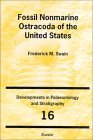
Fossil Nonmarine Ostracoda of the United States The geographic and stratigraphic distribution of fossil nonmarine Ostracoda in the United States are summarized in this book, followed by diagnoses of the subject species, references to literature and 34 plates of illustrations. This work shows the great diversity and usefulness of this interesting class of organisms which are small bivalved aquatic crustaceans that occupy both marine and nonmarine environments. Many are characteristic of estuarine and other tidal habitats, but only a few occupy hypersaline waters. One or two kinds are found in wet soils, or in leaf or flower cups in tropical rain forests. A few live in caves and others are commensal in gills of fish and other aquatic animals. Micropaleontologists have found their shells in many types of sedimentary rocks and have used them for stratigraphic and paleoenvironmental interpretations. Their relatively rapid rates of evolution have made them useful in subsurface stratigraphy and their sensitivity to environmental changes has provided a means of recognizing variations in rock facies. In nonmarine aquatic rocks they are commonly the most easily recoverable microfossils, and have been widely used in petroleum exploration, notably in China, Russia, Brazil and the western United States. |
|
Ostracoda and Global Events |
|
Aspects of Ecology and Zoogeography of Recent and Fossil Ostracoda |
|
Evolutionary Biology and Ecology of Ostracoda Ostracoda (Crustacea) are potentially excellent model organisms for evolutionary studies, because they combine an extensive fossil record with a wide recent distribution and therefore allow studies on both patterns and processes leading to extant diversity. The main scientific domains contributing theories, concepts, and data to evolutionary biology are morphology (including ontogeny), palaeontology, genetics, and ecology, and to all of these aspects ostracods can contribute. This is clearly illustrated by the fifteen papers presented under Theme 3 of the 13th International Symposium on Ostracoda (Chatham, UK) in 1997 which are grouped in the present proceedings, one of three volumes resulting from this meeting. The contributions deal with the evolution of both extant and fossil forms (including most of the Phanaerozoic), ecology of both marine and freshwater taxa, and (developmental) morphology of both soft parts and valves. Although the canvas is wide, each paper clearly shows how studies on Ostracoda can be relevant to general theory on evolutionary biology and ecology. |
 |
Ostracodology - Linking Bio- and Geosciences: Proceedings of the 15th International Symposium on Ostracoda, Berlin, 2005 Ostracods, small aquatic Crustacea, occur in almost every marine, brackish and freshwater habitat. Their calcified bivalved carapaces readily fossilize and their record in earth history is long, dense and diverse. Ostracod species are particularly useful as tools in marine and limnic (palaeo-) ecology, in (palaeo-) biogeography, and biostratigraphy. Their reproductive morphology is as extraordinary as their reproductive modes, and many of their physiological peculiarities remain mysterious. Ostracod taxonomy and phylogeny contribute to general studies of crustacean evolution. The diversity of ostracod applications in both biology and palaeontology is clearly illustrated by the eighteen papers of the 15th International Symposium on Ostracoda (Berlin, Germany) in 2005, which are grouped in the present proceedings, one of three volumes resulting from this meeting. |
 |
Ostracods in British Stratigraphy This book charts the stratigraphical distribution of ostracods in the Cambrian to Pleistocene deposits of Britain and outlines their utility for dating and correlating rock sequences, as well as indicating aspects of their palaeoenvironmental and palaeogeographical significance. These small bivalved crustaceans are the most abundant arthropods in the fossil record. Indeed, the stratigraphy of Britain, which embraces many type-sequences, provides a particularly rich and full record of them, from at least the basal Ordovician, and from the British Cambrian there is a biostratigraphy based on their relatives, the bradoriids and phosphatocopids. Ostracod distributions demonstrate the ecological success story of the group, occupying as they do marine, non-marine and even terrestrial habitats. Written by current specialists in the field, this book is an authoritative account and will be welcomed by all micropalaeontologists and applied geologists in the industrial and academic world alike. It is richly illustrated with over 80 plates of electron micrographs and specially drawn maps, diagrams and range-charts. |