Devonian
- A proposed crinoid zonation of the Devonian deposits of eastern Transbaikal

- Ammonoid and conodont stratigraphy of the late Emsian to early Eifelian (Devonian) at the Jebel Ouaoufilal (near Taouz, Tafilalt, Morocco)
- Depositional environment interpretation and development of the Renanué section (Upper Eifelian- Lower Frasnian; Aragonian Pyrenees, N. Spain)
- Depositional setting of the Devonian/Carboniferous biohermal Bol’shaya Nadota Carbonate Complex, Subpolar Urals
- Detailed correlation of the Devonian deposits in the South Urals and some aspects of their formation
- Devonian
- Devonian
- Devonian
- Devonian
- Devonian and Permian fossils from the Falkland Islands in the biostratigraphy collection of the British Geological Survey
- Devonian Calcareous Algae, Tabulate Corals And Bioclaustrations From The Karakorum Mountains (Northern Pakistan)
- Devonian Mass Extinction
- Devonian Paleogeography, Southwestern US
- Devonian palynological assemblages from the San Antonio x-1 Borehole, Tarija Basin, northwestern Argentina
- Devonian rise in atmospheric oxygen correlated to the radiations of terrestrial plants and large predatory fish
- Devonian System
- Devonian Times
- Devonian/Lower Carboniferous stratigraphy, facies patterns and palaeogeography of Iran Part II. Northern and central Iran
- Devono-carboniferous carbonate platform systems of the Netherlands
- Diversity and palaeoecology of Early Devonian invertebrate associations in the Tafilalt (Anti-Atlas, Morocco)
- Earliest Pragian (Early Devonian) corals and stromatoporoids from reefal settings in the Cantabrian Zone (N Spain)
- End-Devonian extinction and a bottleneck in the early evolution of modern jawed vertebrates
- Facies and palaeoecology of the upper member of the Aisemont Formation (Late Frasnian, S. Belgium): an unusual episode within the Late Frasnian crisis
- Faunal and facies changes at the Early-Middle Frasnian boundary in the north-western East European Platform
- Faunal dynamics across the Silurian–Devonian positive isotope excursions (δ13C, δ18O) in Podolia, Ukraine: Comparative analysis of the Ireviken and Klonk events
- First Records of Late Devonian Entomozoacean Ostracods in North-western Turkey
- Frasnian organic-rich shales in North Africa: Regional distribution and depositional model
- Gamma-ray spectrometry across the Upper Devonian basin succession at Kowala in the Holy Cross Mountains (Poland)
- Givetian-Frasnian boundary at Nismes parastratotype (Belgium): the magnetic susceptibility signal controlled by ferromagnetic minerals
- High-resolution tentaculite biostratigraphy and facies development across the Early Devonian Daleje Event in the Barrandian (Bohemia): implications for global Emsian stratigraphy
- Hydrothermal activities and seawater acidification in the Late Devonian F-F transition: Evidence from geochemistry of rare earth elements
- Late Devonian and Triassic basalts from the southern continental margin of the East European Platform, tracers of a single heterogeneous lithospheric mantle source
- Late Devonian radiolarians from the Rudny Altai (SW Siberia)
- Late Givetian Taghanic bioevents in New York State: New discoveries and questions
- Microbial life in the late Paleozoic: new discoveries from the Early Devonian and Carboniferous
- Middle/Upper Devonian tuffs and Eo-Alpine tectonic evolution in the central Western Greywacke zone, Austria
- Origin of the Devonian peloids in deep wells from the Moesian Platform (Northeastern Bulgaria)
- Ostracods and facies of the Lower and Middle Frasnian at Devils Gate in Nevada: Relationship to the Alamo Event
- Palaeoclimatic event at the Lochkovian-Pragian boundary recorded in magnetic susceptibility and gamma-ray spectrometry (Prague Synclinorium, Czech Republic)
- Paleomagnetism of the Silurian-Devonian Andreas redbeds: Evidence for an Early Devonian supercontinent?
- Paleontological Exhibit of Ordovician Trentorian Fauna
- Palynology and microfacies of Lower Devonian mixed carbonate-siliciclastic deposits in Podolia, Ukraine
- Revision of the Upper Devonian in the Central-Southern Appalachian Basin: Biostratigraphy and Lithostratigraphy
- Sedimentary geochemistry and provenance of the Lower and Middle Devonian Laojunshan Formation, the North Qilian Orogenic Belt
- Sedimentary record of eustatic changes on the Givetian (Devonian) carbonate platform of Małopolska Massif, southern Poland
- Selected benthic faunas from the Devonian of the Ardennes: an estimation of palaeobiodiversity
- Silurian-Devonian boundary events and their influence on cephalopod evolution: evolutionary significance of cephalopod egg size during mass extinctions
- Stratigraphical distribution and palynological correlation between devonian Formations from North Dobrogea and East European Platform
- Stratigraphical distribution of Givetian ostracods in the type-area of the Fromelennes Formation (Fromelennes, Ardennes, France) and their relationship to global events
- Stratigraphy of the Devonian
- Stratigraphy of the Lower Devonian sediments in the northwestern Shan Plateau, Myanmar
- Taphonomy of the vertebrate bone beds from the Klūnas fossil site, Upper Devonian Tērvete Formation of Latvia
- Temporal evolution, petrography and composition of dolostones in the Upper Devonian Plavinas Regional Stage, southern Estonia and northern Latvia
- Timing of the onset of Devonian sedimentation in northwestern Poland: palynological evidence
- Towards a palaeogeographical and sequential framework for the Givetian of Belgium
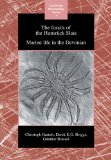 |
The Fossils of the Hunsrück Slate: Marine Life in the Devonian This beautifully illustrated book describes one of the most famous fossil deposits known: the Hunsrück Slate of Germany. These spectacular fossils, in which not just the hard parts but also the soft-tissues of the animals are preserved in pyrite in many cases, provide the most complete record available of life in the Devonian seas. First published in 1998, the book provides a comprehensive account of these remarkable fossils. It is written in an accessible style, and is extensively illustrated with photographs and X-radiographs of many of the finest specimens. The book reviews the different plant and animal groups, and includes a complete taxonomic list and comprehensive bibliography. It will be of most value to researchers and graduate students in palaeontology, geology and evolutionary biology, but it will also be of interest to amateur collectors and natural historians. |
 |
Devonian Events and Correlations The Devonian was a peculiar period, characterized by simplified plate tectonic configurations, climatic overheating and widely flooded continents. The bloom of fishes and ammonoids, extensive reef complexes, and the conquest of land indicate major biosphere innovations, punctuated by many global events, including two of the biggest mass extinctions. The Devonian was the first system for which subdivisions were formally defined. This was achieved by significant advances in pelagic biostratigraphy. The chronostratigraphic framework and interdisciplinary techniques allow us to correlate intervals or sudden events across facies boundaries, in order to reconstruct the sedimentary and evolutionary history of the system with highest precision. This volume honors the lifetime stratigraphic achievements of Michael Robert House (1930-2002). Based on case studies from Europe, North Africa and North America, it shows how the combination of biostratigraphy, chemostratigraphy, magnetostratigraphy, sequence stratigraphy and event stratigraphy can contribute to a much deeper understanding of both regional and global environmental change. |
 |
Devonian Change: Case studies in Palaegeography and Palaeoecology |
 |
The Late Devonian Mass Extinction McGhee thoroughly assesses knowledge about the Late Devonian mass extinction, during which at least 70 percent of species vanished. The text is so comprehensive and well written, though, that it could serve as a basic resource for thinking about all extinctions, mass or otherwise: the severity of the extinction, its duration, the various organisms affected, and likely causes. His approach is based first on a description of the evidence, and then on an analysis of the hypotheses . . . The objectivity of the book is enhanced by the author's willingness to even disagree with his own previous work . . . Anyone interested in extinctions should have this book. -- Choice |