Igneous rocks
- A comparative study on two trondhjemitic rock-series of different origin from the Mureş ophiolitic suture, Romania

- A database of plagioclase crystal preferred orientations (CPO) and microstructures – implications for CPO origin, strength, symmetry and seismic anisotropy in gabbroic rocks
- Advective heat transfer and fabric development in a shallow crustal intrusive granite – the case of Proterozoic Vellaturu granite, south India
- AFC-Modeler: a Microsoft® Excel© workbook program for modelling assimilation combined with fractional crystallization (AFC) process in magmatic systems by using equations of DePaolo (1981)
- Al-in-Hornblende Thermobarometry and Sr-Nd-O-Pb Isotopic Compositions of the Early Miocene Alaçam Granite in NW Anatolia (Turkey)
- Anatectic migmatites from the roof of an ocean ridge magma chamber
- Arc Basalt Simulator version 2, a simulation for slab dehydration and fluid-fluxed mantle melting for arc basalts: Modeling scheme and application
- Archaean Zircon U-Pb Age Paradox in Juvenile Neoproterozoic Granitoids, Central North Sudan, Saharan Metacraton
- Basalt 2013 - Cenozoic Magmatism in Central Europe - April 24-28 2013, Goerlitz, Germany
- Characteristics of pegmatoidal granite exposed near Bayalan, Ajmer district, Rajasthan
- Chromite-hosted Silicate Melt Inclusions from Basalts in the Stravaj Complex, Southern Mirdita Ophiolite Belt (Albania)
- Chronology and petrogenesis of the Hejiazhuang granitoid pluton and its constraints on the Early Triassic tectonic evolution of the South Qinling Belt
- Classification of Granitic Pegmatites Revisited
- Clinopyroxene from basaltic rocks of the Erzgebirge - Krušné hory Mts. - implications for modelling the magmatic plumbing system
- Comparison of geological, textural and petrographic characteristics of the pillow lava flows from the areas of Malo Buchino, Babitsa and Nеdelkovo villages (Western Srednogorie)
- Complete preservation of ophiolite suite from south Andaman, India: A mineralchemical perspective
- Compositional diversity of Eocene-Oligocene basaltic magmatism in the Eastern Rhodopes, SE Bulgaria: implications for genesis and tectonic setting
- Compositional Variations, Zoning Types and Petrogenetic Implications of Low-pressure Clinopyroxenes in the Neogene Alkaline Volcanic Rocks of Northeastern Turkey
- Contemporaneous Late Cretaceous Calc-alkaline and Alkaline Magmatism in Central Anatolia, Turkey: O Isotope Constraints on Petrogenesis
- Continental margin ophiolites of Neotethys: Remnants of Ancient Ocean–Continent Transition Zone (OCTZ) lithosphere and their geochemistry, mantle sources and melt evolution patterns
- Contrasting magmatic signatures in the Rairakhol and Koraput alkaline complexes, Eastern Ghats belt, India
- Death of super-continents and birth of oceans heralded by discrete A-type granite igneous events: the case of the Variscan-Alpine Europe
- Different Degrees of Partial Melting of the Enriched Mantle Source for Plio−Quaternary Basic Volcanism, Toprakkale (Osmaniye) Region, Southern Turkey
- Digital Concentration-Distribution Models – tools for a describing heterogeneity of the hybridized magmatic mass as reflected in elemental concentration of growing crystal
- Dikili-Çandarlı Volcanics, Western Turkey: Magmatic Interactions as Recorded by Petrographic and Geochemical Features
- Discriminating four tectonic settings: Five new geochemical diagrams for basic and ultrabasic volcanic rocks based on log–ratio transformation of major-element data
- Evaluation of a permeability-porosity relationship in a low permeability creeping material using a single transient test
- Felsic tuff from Rutland Island – A pyroclastic flow deposit in Miocene-sediments of Andaman-Java subduction complex
- Flood basalts, mantle plumes and mass extinctions
- Fluid mechanics inside a volcano
- Fore-arc basalts and subduction initiation in the Izu-Bonin-Mariana system
- From basalts to boninites: the geodynamics of volcanic expression during subduction initiation
- Garnet pyroxenite in the Biskupice peridotite, Bohemian Massif: anatomy of a Variscan high-pressure cumulate
- Geochemical and isotopic (Sr, Nd and O) constraints on sources for Variscan granites in the Western Carpathians - implications for crustal structure and tectonics
- Geochemical and Isotopic Constraints on Petrogenesis of the Beypazarı Granitoid, NW Ankara, Western Central Anatolia, Turkey
- Geochemical and Sm–Nd isotopic study of titanite from granitoid rocks of the eastern Dharwar craton, southern India
- Geochemical and Sr-Nd Isotopic Characteristics of Post-Collisional Calc-Alkaline Volcanics in the Eastern Pontides (NE Turkey)
- Geochemical and temporal evolution of Cenozoic magmatism in Western Turkey: Mantle response to collision, slab break-off, and lithospheric tearing in an orogenic belt
- Geochemical Characteristics of Mafic and Intermediate Volcanic Rocks from the Hasandağ and Erciyes Volcanoes (Central Anatolia, Turkey)
- Geochemical characteristics of Mesoproterozoic metabasite dykes from the Chhotanagpur Gneissic Terrain, eastern India: Implications for their emplacement in a plate margin tectonic environment
- Geochemical study of volcanic and associated granitic rocks from Endau Rompin, Johor, Peninsular Malaysia
- Geochemistry and petrogenesis of Neoproterozoic Mylliem granitoids, Meghalaya Plateau, northeastern India
- Geochemistry and petrology of the ophiolitic rocks from the Kahramanmaraş region, southern Turkey
- Geochemistry and petrology of pyroxenite xenoliths from Cenozoic alkaline basalts, Bohemian Massif
- Geochemistry and Tectonic Environment of Diverse Magma Generations Forming the Crustal Units of the Kızıldağ (Hatay) Ophiolite, Southern Turkey
- Geochemistry of abyssal peridotites from the super slow-spreading Southwest Indian Ridge near 65°E: Implications for magma source and seawater alteration
- Geochemistry of Igneous Rocks
- Geochemistry of the Jurassic Mirdita Ophiolite (Albania) and the MORB to SSZ evolution of a marginal basin oceanic crust
- Geochemistry of the Middle Miocene Collision-Related Yamadaği ( Eastern Anatolia) Calc-Alkaline Volcanics, Turkey
- Geological characteristics and setting of ophiolitic mélange around Tokat (Dumanli dagh) and Sivas (Çeltek dagh) region
- Geological characteristics and structural evolution of the ophiolitic units around Sakaltutan Dagi (Erzurum)
- Geological position, mineral assemblages and contamination of granitic pegmatites in the Moldanubian Zone, Czech Republic; examples from the Vlastějovice region
- Global pulsations of intraplate magmatism through the Cenozoic, Lithosphere
- How To Know About Igneous Rocks

- Hurst exponent as a tool for the description of magma field heterogeneity reflected in the geochemistry of growing crystals
- Hydrothermal alteration studies of gabbros from Northern Central Indian Ridge and their geodynamic implications
- Hydrothermal insights from the Troodos ophiolite, Cyprus
- Hydrothermally Opalized Serpentinites in Tethyan Ophiolite Sequence in Central Serbia
- Igneous Geochemistry
- Igneous Petrology (Geo301)
- Igneous rocks (Geology 200a)
- Igneous Rocks
- Igneous Rocks
- Igneous Rocks Home Page
- Igneous Rock Identification Exercise
- Inner structure and age of emplacement of the ophiolitic mélange between Tokat and Sivas provinces
- Intrusive Igneous Rocks
- Late Devonian and Triassic basalts from the southern continental margin of the East European Platform, tracers of a single heterogeneous lithospheric mantle source
- Layering and schlieren in granitoids: A record of interactions between magma emplacement, crystallization and deformation in growing plutons (The André Dumont medallist lecture)
- Mafic-Ultramafic Large Igneous Provinces (LIPs): Importance of the Pre-Mesozoic record
- Magma Interaction Processes Inferred from Fe-Ti Oxide Compositions in the Dölek and Sarıçiçek Plutons, Eastern Turkey
- Magma Interaction Recorded in Plagioclase Zoning in Granitoid Systems, Zigana Granitoid, Eastern Pontides, Turkey
- Magmatic dyke systems of the South Shetland Islands volcanic arc (West Antarctica): reflections of the geodynamic history
- Magmatic processes at the volcanic front of Central Mexican Volcanic Belt: Sierra de Chichinautzin Volcanic Field (Mexico)
- Mantle plume activity and melting conditions: Evidence from olivines in picritic-komatiitic rocks from the Emeishan Large Igneous Province, southwestern China
- Microtextural and mineral chemical analyses of andesite–dacite from Barren and Narcondam islands: Evidences for magma mixing and petrological implications
- Migrating shoshonitic magmatism tracks Izu-Bonin- Mariana intra-oceanic arc rift propagation
- Mineral and Whole-rock Geochemistry of the Kestanbol Granitoid (Ezine-Çanakkale) and its Mafic Microgranular Enclaves in Northwestern Anatolia: Evidence of Felsic and Mafic Magma Interaction
- Mineral Chemistry and Petrochemistry of Post-Collisional Tertiary Mafic to Felsic Cogenetic Volcanics in the Ulubey (Ordu) Area, Eastern Pontides, NE Turkey
- Mineral chemistry of lava flows from Linga area of the Eastern Deccan Volcanic Province, India
- Mineral chemistry of Pangidi basalt flows from Andhra Pradesh
- Missing link between granites and granitic pegmatites
- Modification of magnetic properties in granite during hydrothermal alteration (EPS-1 borehole, Upper Rhine Graben)
- Nature and efficiency of pyroclast generation from porous magma: Insights from field investigations and laboratory experiments
- Neoproterozoic Ophiolites of the Arabian-Nubian Shield
- Non-explosive interaction of magma and wet unconsolidated volcaniclastics: case study from the Sushevo trachydacite cryptodomes, East Rhodopes
- Non-Newtonian effects in silicate liquids and crystal bearing melts: Implication for magma dynamics
- North Atlantic Igneous province
- Ophiolites and Ophiolitic Melanges of Turkey: A Review
- Ophiolitic Molasse Unit of Ikaria Island (Greece)
- Organization of volcanic plumbing through magmatic lensing by magma chambers and volcanic loads
- Origin of Back-arc Basin Magmas: Trace Element and Isotopic Perspectives
- Origin of mantle peridotites from the Vourinos Ophiolite Complex, Greece, as deduced from Cr-spinel morphological and chemical variations
- Overview of the genesis and emplacement of Mesozoic ophiolites in the Eastern Mediterranean Tethyan region
- Paleo-thermal Effects of Igneous Intrusions in Sedimentary Basins and Their Influence on Petroleum Systems
- Peridotites derived from a ductile shear zone within backarc lithospheric mantle, southern Mariana Trench: results of a Shinkai 6500 dive
- Petrogenesis of Late Cretaceous Adakitic Magmatism in the İstanbul Zone (Çavuşbaşı Granodiorite, NW Turkey)
- Petrogenesis of the Kösedağ Pluton, Suşehri-NE Sivas, East-Central Pontides, Turkey
- Petrogenesis of the Refahiye Ophiolite and its Tectonic Significance for Neotethyan Ophiolites Along the İzmir-Ankara-Erzincan Suture Zone
- Petrographic and mineralogical characterisation of fractionated pegmatites culminating in the Nb-Ta-Sn pegmatites of the Gatumba area (western Rwanda)
- Petrography and Petrology of the Calc-Alkaline Sarıhan Granitoid (NE Turkey): An Example of Magma Mingling and Mixing
- Pétrologie Endogene
- Petrology, geochemistry of hornblende gabbro and associated dolerite dyke of Paharpur, Puruliya, West Bengal: Implication for petrogenetic process and tectonic setting
- Petrology of the İspendere (Malatya) ophiolite from the Southeast Anatolia: implications for the Late Mesozoic evolution of the southern Neotethyan ocean
- PETROMODELER (Petrological Modeler): a Microsoft® Excel© spreadsheet program for modelling melting, mixing, crystallization and assimilation processes in magmatic systems
- Petrophysical and geochemical characteristics of late Variscan granites in the Karlovy Vary Massif (Czech Republic) - implications for gravity and magnetic interpretation in shallow depths
- PETROS Igneous Petrology Databank
- Pre-ocean and post-collision intraplate basalts from Romania: A comparative study
- Pyroclastic stratigraphy of the acid volcaniclastics (2-nd Rupelian phase) near Plazishte (Dzhebel) and Kostino (Kardzhali) villages, Eastern Rhodopes – a comparative study
- Rapid emplacement of the Oman ophiolite: Thermal and geochronologic onstraints
- Rapid emplacement of young oceanic lithosphere: Argon geochronology of the Oman ophiolite
- Relationship between chemical composition and magnetic susceptibility in the alkaline volcanics from the Isparta area, SW Turkey
- Roches et minéraux magmatiques
- Role of serpentinites in cycling of carbon and sulfur: Seafloor serpentinization and subduction metamorphism
- Seismic interpretation and characterization of igneous rocks in Jan Mayen Microcontinent, Norwegian-Greenland Sea
- Serpentinization and carbon sequestration: A study of two ancient peridotite-hosted hydrothermal systems
- Sidi Mohamed peridotites (Edough Massif, NE Algeria): Evidence for an upper mantle origin
- Silicic Large Igneous Provinces
- Source and Petrogenesis of the Igneous Complex Cored during ODP Leg 205: Implications for Off-Axis Plume-Ridge Interaction on the Cocos Plate
- Sr and Nd Isotopic Characteristics of Some S-, I- and A-type Granitoids from Central Anatolia
- Statistical Evaluation of Classification Diagrams for Altered Igneous Rocks
- Stratigraphy and Geochemical Features of the Early Miocene Bimodal (Ultrapotassic and Calc-alkaline) Volcanic Activity Within the NE-trending Selendi Basin, Western Anatolia, Turkey
- Studies of Magmatic Systems
- Studies of volatile evolution in magmatic systems using melt inclusions
- 'Subduction initiation rule': A key for linking ophiolites, intra-oceanic forearcs and subduction initiation
- Sulfur geochemistry of peridotite-hosted hydrothermal systems: Comparing the Ligurian ophiolites with oceanic serpentinites
- Suprasubduction zone ophiolite formation along the periphery of Mesozoic Gondwana
- Suprasubduction zone ophiolites and Archean tectonics
- Tectonic implications of ca. 1.45 Ga granitoid magmatism at the southwestern margin of the East European Craton
- Tectonic Implications of Some Cretaceous Pillow Basalts from the North Anatolian Ophiolitic Mélange(Central Anatolia-Turkey) to the Evolution of Neotethys
- Textural and Compositional Evidence for Magma Mixing in the Evolution of the Çamlıdere Volcanic Rocks (Galatean Volcanic Province), Central Anatolia, Turkey
- Two Primary Basalt Magmatypes from Northwest Rota-1 Volcano, Mariana Arc
- U-Pb zircon SHRIMP ages, geochemical and Sr-Nd isotopic compositions of the Early Cretaceous I-type Sarıosman pluton, Eastern Pontides, NE Turkey
- Understanding silicic volcanism: Constraints from elasticity and failure of vesicular magma
- Uptake of carbon and sulfur during seafloor serpentinization and the effects of subduction metamorphism in Ligurian peridotites
- Volcanic Rocks From Foça-Karaburun and Ayvalik-Lesvos grabens (Western Anatolia) and Their Petrogenetic-Geodynamic Significance
- Water-rich basalts at mid-ocean-ridge cold spots
- Whole Rock and Mineral Chemistry of Ultramafic-mafic Cumulates from the Orhaneli (Bursa) Ophiolite, NW Anatolia
Books about igneous rocks
 |
Principles of Igneous and Metamorphic Petrology (2nd Edition) With enough background to be rigorous, yet not exhaustive, this book offers good preparation in the techniques of modern petrology; a clear and organized review of the classification, textures, and approach to petrologic study; and applies these concepts to the real occurrences of the rocks themselves. The goal throughout is for readers to be able to apply the techniques—and enjoy the insights of the results—rather than tinker with theory and develop everything from first principles. A survey of actual occurrences of igneous and metamorphic rocks, and processes that produce them, is provided. This section is often greatly condensed in most other books, but it is the most interesting and dynamic aspect of petrology. |
|
Igneous Petrology The field of Igneous Petrology has evolved greatly in the past years. McBirney's NEW Third Edition, completely revised and updated, presents a modern and integrated survey of the geological and genetic relations of igneous rocks. It illustrates how modern geochemical and geophysical methods can be combined with field relations to understand the generational and compositional evolution of magmas. |
|
Atlas of Igneous Rocks and Their Textures Atlas of igneous rocks and their textures A companion volume to the Atlas of Rock-forming Minerals in Thin Section, this full-colour handbook is designed to be used as a laboratory manual both by elementary students of earth sciences undertaking a study of igneous rocks in thin section under the microscope, and by more advanced students and teachers as a reference work. The book is divided into two parts — Part One is devoted to photographs of many of the common textures found in igneous rocks with brief descriptions accompanying each photograph. Part Two illustrates the appearance of examples of some sixty of the commonest (and a few not so common) igneous rock types; each photograph is accompanied by a brief description of the field of view shown. Nearly 300 full-colour photographs are included, and in many cases the same view is shown both in plane-polarized light and under crossed polars. A brief account of how thin sections can be prepared is included as an appendix. It is believed that the amateur geologist using these instructions will be able to make his own thin sections and, with the aid of a relatively simple microscope, enjoy the study of rocks in thin section. |
|
Igneous and Metamorphic Rocks under the Microscope: Classification, textures, microstructures and mineral preferred orientation This is the first modern text to provide a thorough integrated treatment of those parts of the subject that use the polarizing microscope as the central analytical tool. The book is divided into three parts and a comprehensive glossary/index provides easy access to the contents of the book. |
|
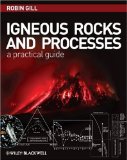
Igneous Rocks and Processes This book is for geoscience students taking introductory or intermediate-level courses in igneous petrology, and helps them develop key skills (and confidence) in identifying igneous minerals, and in interpreting – and allocating appropriate names to – unknown rocks presented to them. The book thus serves, uniquely, both as a conventional course text and as a practical laboratory manual. Following an introduction reviewing igneous nomenclature, each chapter addresses a specific compositional category of magmatic rocks, covering definition, mineralogy, eruption/ emplacement processes, textures and crystallization processes, geotectonic distribution, geochemistry, and aspects of magma genesis. One chapter is devoted to phase equilibrium experiments and magma evolution; another introduces pyroclastic volcanology. Each chapter concludes with exercises, answers being provided at the end of the book. Appendices provide a summary of techniques and optical data for microscope mineral identification, an introduction to petrographic calculations, a glossary of petrological terms, and a list of symbols and units. The book is richly illustrated with line drawings, monochrome pictures and colour plates. |
 |
Mind over Magma: The Story of Igneous Petrology |
 |
Volcaniclastic Rocks, from Magmas to Sediments Recent research has emphasised the important part played by tephra during the evolution of volcanoes and their subsequent emission. Huge amounts of volcaniclasts are released by explosive volcanoes with significant impact on diverse aspects such as population safety, hydrology and the filling of sedimentary basins. This volume examines the production, transport and deposition of volcaniclasts (tephra and epiclasts) as well as their economic geology, particular in terms of reservoir engineering, hydrothermalism and hydrothermal mineralisations, hazard and development. Volcaniclastic Rocks, from Magmas to Sediments is an excellently written and beautifully illustrated textbook compiled by a multidisciplinary group of experts which will be of great value to postgraduates, researchers and working professionals in the earth sciences, especially in volcanology as well as economic, engineering and environmental geology. |
 |
Origin of Igneous Rocks: The Isotopic Evidence The origin of different kinds of igneous rocks can be understood in terms of the tectonic setting in which they form and in terms of the isotope compositions of the strontium, neodymium, and lead they contain. This book explains the petrogenesis of igneous rocks as a consequence of tectonic processes resulting from interactions between asthenopheric plumes and the overlying lithospheric mantle. The relevant principles of isotope geochemistry are explained in the first chapter, making this book accessible to university students as well as to professionals. The relevant isotopic data are presented in diagrammatic form. In addition, the text avoids the use of acronyms. |
 |
Igneous Rocks: A Classification and Glossary of Terms: Recommendations of the International Union of Geological Sciences Subcommission on the Systematics of Igneous Rocks Decades of field and microscope studies, and more recent quantitative geochemical analyses have resulted in a vast, and sometimes overwhelming, array of nomenclature and terminology associated with igneous rocks. This book presents a complete classification of igneous rocks based on all the recommendations of the International Union of Geological Sciences (IUGS) Subcommission on the Systematics of Igneous Rocks. The glossary of igneous terms has been fully updated since the first edition and now includes 1637 entries, of which 316 are recommended by the Subcommission. Incorporating a comprehensive bibliography of source references for all the terms included in the glossary, this book is an indispensable reference guide for all geologists studying igneous rocks, either in the field or the laboratory. It presents a standardised and widely accepted naming scheme that will allow geologists to interpret terminology in the primary literature and provide formal names for rock samples based on petrographic analyses. It is also supported by a website with downloadable code for chemical classifications. |
 |
The Field Description of Igneous Rocks The Second Edition of this unique pocket field guide has been thoroughly revised and updated to include advances in physical volcanology, emplacement of magmas and interpreting structures and textures in igneous rocks. The book integrates new field based techniques (AMS and geophysical studies of pluton shape) with new topics on magma mixing and mingling, sill emplacement and magma sediment interaction. Part of the successful Field Guide series, this book includes revised sections on granitic and basaltic rocks and for the first time a new chapter on the engineering properties of igneous rocks. |
 |
Physical Geology of High-level Magmatic Systems This book gives an up-to-date overview of the physical geology of sub-volcanic intrusions. Topics covered in this wide-ranging volume include important aspects of the field geology and physical volcanology of sills, laccoliths and sub-volcanic complexes, magma-sediment interaction and numerical and experimental studies aimed at quantifying more precisely the emplacement mechanics of high-level magmatic intrusions. Provocative papers ask whether laccoliths and high-level sills are forming today, and question the nature of the relationship between high-level intrusions and contemporaneous volcanic activity. Several contributions also deal with the more applied aspects of high-level magma emplacement and 3D seismic imaging of sill and laccolith complexes as relevant to the hydrocarbons industry. It is hoped that with the publication of this volume a consensus will emerge that will help to advance our understanding of the more important physical factors governing the emplacement of high-level intrusions in the continental crust, along with their wider geotectonic implications. |
 |
Timescales of Magmatic Processes: From Core to Atmosphere Quantifying the timescales of current geological processes is critical for constraining the physical mechanisms operating on the Earth today. Since the Earth’s origin 4.55 billion years ago magmatic processes have continued to shape the Earth, producing the major reservoirs that exist today (core, mantle, crust, oceans and atmosphere) and promoting their continued evolution. But key questions remain. When did the core form and how quickly? How are magmas produced in the mantle, and how rapidly do they travel towards the surface? How long do magmas reside in the crust, differentiating and interacting with the host rocks to yield the diverse set of igneous rocks we see today? How fast are volcanic gases such as carbon dioxide released into the atmosphere? This book addresses these and other questions by reviewing the latest advances in a wide range of Earth Science disciplines: from the measurement of short-lived radionuclides to the study of element diffusion in crystals and numerical modelling of magma behaviour. It will be invaluable reading for advanced undergraduate and graduate students, as well as igneous petrologists, mineralogists and geochemists involved in the study of igneous rocks and processes. |
 |
Igneous Petrogenesis A Global Tectonic Approach As a major text in igneous petrology, this innovative book offers a much-needed, radically different approach to the study of igneous rocks. Bridging a long-recognized gap in the literature by providing petrogenic models for magmatismin terms of global tectonic processes, it encompasses geophysics and geochemistry in a comprehensive treatment of the subject. Most textbooks in igneous petrology have intended to avoid discussion of potentially controversial petrogenetic models. However, this is precisely the sort of information senior students of igneous petrology require. Dr Wilson has drawn on 15 years of research and 10 years of teaching experience in writing an account of what is now a well established understanding of the processes involved in environments of magma generation. She provides full discussions of the major-element, trace-element, and radiogenic isotope characteristics of magmas generated in different tectonic settings and she deals with the information derived from such data concerning magma source regions and their ascent trough the Earth's lithosphere. Additionally each chapter contains a summary of geophysical data relating to crustal and mantle structure and the location of magma reservoirs. The modular format of the book will facilitate its use by all students, researchers and professionals with an interest in igneous petrology. A basic knowledge of geochemistry, mineralogy, phase diagrams, regional geology and global tectonics is assumed, but such advanced topics as trace element and isotope geochemistry can be omitted initially if the reader's background is inappropriate. The text is profusely illustrated and the bibliography contains over 1000 carefully selected references. Marge Wilson graduated in geology at the University of Oxford. She then spent a year at the University of California, Berkeley, and subsequently studied the petrogenesis of nepheline syenites from the Gardar province of Greenland, leading to a PhD from the University of Leeds. Her research has focused on island-arc, oceanic-island and intra-continental plate tectonic settings. |