Geology of Asia
- A Geological and Geophysical Information System for Eurasia, The Middle East and North Africa
- A major reorganization of Asian climate regime by the early Miocene

- Arabia-Somalia plate kinematics, evolution of the Aden-Owen-Carlsberg triple junction, and opening of the Gulf of Aden
- Birth of the Himalaya
- CGMME - Commission for the Geological Map of the Middle East
- Continental Lithosphere of the Arabian Plate: A Geologic, Petrologic, and Geophysical Synthesis
- Controls on the sequence stratigraphic architecture of the Neogene Zagros foreland basin
- Coordinating Committee for Geoscience Programmes in East and Southeast Asia (CCOP)
- Cornell University's Middle East and North Africa Project
- Design and development of information systems for the geosciences: An application to the Middle East
- Flexural bending of the Zagros foreland basin
- Geology and geophysics of the Philippine Sea and adjacent areas in the Pacific Ocean
- Geology and hydrocarbon potential of Neoproterozoic–Cambrian Basins in Asia: an introduction
- Geology and Petroleum Potential of Central Asia
- IGCP Project No.369 - Comparative Evolution of PeriTethyan Rift Basins
- Middle East Stratigraphy
- Nanga Parbat - Mountain Uplift And Tectonics
- Neogene sediments and modern depositional environments of the Zagros foreland basin system
- Neoproterozoic tectonics of the Arabian-Nubian Shield
- Post-Collisional Deposits in the Zagros Foreland Basin: Implications for Diachronous Underthrusting
- Step-wise change of Asian interior climate preceding the Eocene-Oligocene Transition (EOT)
- Thermal and tectonic consequences of India underthrusting Tibet
- Topography, Tectonics, Climate & Erosion in the Himalayas
- Zagros Foreland Basin

- Azerbaijan National Academy of Science - Geology Institute
- A magnetostratigraphic time frame for Plio-Pleistocene transgressions in the South Caspian Basin, Azerbaijan
- Geochemical constraints on the Paleocene-Miocene evolution of eastern Azerbaijan, with implications for the South Caspian basin and eastern Paratethys
- Stratigraphy and geochemical characterization of the Oligocene-Miocene Maikop series: Implications for the paleogeography of Eastern Azerbaijan
- Geological Survey of India
- Paleontological Society of India
- Wadia Institute of Himalayan Geology
- δ13C stratigraphy of the Birmania Basin, Rajasthan, India: implications for the Vendian - Cambrian transition
- C- and O-Isotopic characteristics of Neoproterozoic Sihohi Group meta-carbonatesin NW India and their paleoclimatic implications
- Carbon and oxygen isotope geochemistry of Neoproterozoic limestones of the Shahabad Formation, Bhima basin, Karnataka, southern India
- Carbon and oxygen isotopic variations in stromatolitic dolomites of Palaeoproterozoic Vempalle Formation, Cuddapah Basin, India
- Characterization of C-isotope variability in the Delhi Supergroup, northwestern India and the Mesoproterozoic ocean
- Geology of India
- Geology of Zanskar
- Gravity anomalies, crustal structure and rift tectonics at the Konkan and Kerala basins, western continental margin of India
- High-resolution seismic imaging of the Sohagpur Gondwana basin, central India: Evidence for syn-sedimentary subsidence and faulting
- Hydrocarbon Prospectivity of Indian Sedimentary Basins-A Review
- Modal analysis and geochemistry of two sandstones of the Bhander Group (Late Neoproterozoic) in parts of the Central Indian Vindhyan basin and their bearing on the provenance and tectonics
- Neoproterozoic–Early Cambrian isotopic variation and Chemostratigraphy of the Lesser Himalaya, India, Eastern Gondwana
- Pb–Pb zircon ages of Archaean metasediments and gneisses from the Dharwar craton, southern India: Implications for the antiquity of the eastern Dharwar craton
- Permian Triassic palynofloral transition in Chintalapudi area, Godavari Graben, Andhra Pradesh, India
- Permian–Triassic palynostratigraphy in Mailaram area, Godavari Graben, Andhra Pradesh, India
- Quilon Limestone (Kerala Basin/India) - an archive for Miocene Indo-Pacific seagrass beds
- Rajasthan - Geology
- South India Precambrian crust and shallow lithospheric mantle: Initial results from the India Deep Earth Imaging Experiment (INDEX)
- Strain analysis and stratigraphic status of Nongkhya, Sumer and Mawmaram conglomerates of Shillong basin, Meghalaya, India
- Stratigraphic and palaeoenvironmental framework of the Early Permian sequence in the Salt Range, Pakistan
- Basic Principle of Geology of Iraq
- Facies Analysis and Depositional Environment of Garagu Formation (Valanginian-Hauterivian) in Gara Mountain, Gali Garagu, Sarsang District, Iraqi Kurdistan Region
- Facies variation, diagenesis and exploration potential of the Cretaceous rudist-bearing carbonates of the Arabian Gulf
- Generation and expulsion history of oil-source rock (Middle Jurassic Sargelu Formation) in the Kurdistan of north Iraq, Zagros folded belt: Implications from 1D basin modeling study
- Geochemistry links source rocks, crude distribution in northern Mesopotamian basin, Iraq
- Geothermal gradients in Iraqi Kurdistan deduced from bottom hole temperatures
- GIS in an Overview of Iraq Petroleum Geology
- Iraq: Resource Base (GeoExPro)
- Microfacies, Diagenesis and Biostratigraphy of Balambo Formation from Azmer Mountains in North-Eastern Sulaimaniya (Kurdistan-Iraq)
- Organic Geochemical Assessment of Jurassic Potential Source Rock From Zab-1 Well, Iraqi Kurdistan
- Petroleum Geology and Total Petroleum Systems of the Widyan Basin and Interior Platform of Saudi Arabia and Iraq
- Petroleum Source Rock Analysis of the Jurassic Sargelu Formation, Northern Iraq
- Petroleum Systems Elements and Structural Geology in Northern Iraq
- Recommendation for A Practical Log-based Stratigraphic Framework for the Kurdistan Region of Iraq
- Rock-Eval Pyrolysis Results from the Bijeel 1 Well, Kurdistan Region, Iraq
- Sedimentology of Sinjarand Khurmala Formations (Paleocene-Lower Eocene) in Northern Iraq
- Sequence Stratigraphy of Upper Cretaceous Tanjero Formation in Sulaimaniya Area, NE-Iraq
- Stratigraphical nomenclature for Iraq
- Stratigraphy, lithofacies distribution and petroleum potential of the Triassic strata of the Northern Arabian plate
- Stratigraphy, microfacies, and petroleum potential of the Mauddud Formation (Albian– Cenomanian) in the Arabian Gulf basin
- Structural and tectonic setting of Zagros fold-and-thrust belt, NE Kurdistan
- Structural evolution of the northwestern Zagros, Kurdistan Region, Iraq: Implications on oil migration
- Tectonic and depositional history of Upper Cretaceous Tanjero Formation in Sulaimaniya Area, NE-Iraq
- Tertiary of the Arabian Gulf: sedimentology and hydrocarbon potential
- A Late Neoproterozoic (~630Ma) Boninitic Suite from southern Israel: Implications for the Consolidation of Gondwanaland
- Controls and evolution of facies patterns in the Upper Barremian–Albian Levant Platform in North Sinai and North Israel
- Foraminiferal assemblage-based biostratigraphy and correlation of the Triassic of northern Israel
- Anatomy of a world-class source rock: Distribution and depositional model of Silurian organic-rich shales in Jordan and implications for hydrocarbon potential
- Deformation at a strike-slip, stepover zone along the southeastern margin of the Dead Sea pullapart basin, Jordan
- Early diagenesis of Late Cretaceous chalk-chert-phosphorite hardgrounds in Jordan: implications for sedimentation on a Coniacian-Campanian pelagic ramp
- Early Turonian shallow marine red beds on the Levant carbonate platform (Jordan), Southern Tethys
- Evolution of Cretaceous to Eocene alluvial and carbonate platform sequences in central and south Jordan
- Geologic Development of Jordan - Evolution of its Rocks and Life
- Late- and post-orogenic Neoproterozoic intrusions of Jordan: Implications for crustal growth in the northernmost segment of the East African Orogen
- Morphotectonic structure of the lower Jordan Valley – an active segment of the Dead Sea Rift
- Orbital time scale, intra-platform basin correlation, carbon isotope stratigraphy and sea-level history of the Cenomanian–Turonian Eastern Levant platform, Jordan
- Pella Museum - Paleontology & Geology of Jordan
- Permian and Triassic Strata of Jordan
- Petroleum Geology of Jordan
- Platform cofiguration, microfacies and cyclicities of the upper Albian to Turonian of west-central Jordan
- Stratigraphy, lithofacies distribution and petroleum potential of the Triassic strata of the Northern Arabian plate
- Tectonic control in the geomorphologic development of theWadi el-Mujib canyon (Jordan)
- Tectonic evolution in the Wadi Araba Segment of the Dead Sea Rift, South-West Jordan
- Paleocene and Eocene floristic and climatic change in Russia and Northern Kazakhstan
- Palaeoenvironmental conditions of hardgrounds formation in the Late Turonian-Coniacian of Mangyshlak Mountains, Western Kazakhstan
- Paleozoic Geography and Paleomagnetism of Kazakhstan
- Petroleum Geology of Kazakhstan
- Ultra-rapid exhumation of ultrahigh pressure diamond-bearing metasedimentary rocks of the Kokchetav Massif
- Biofacies, Palaeo-environments and Stratigraphy of the Ratawi, Minagish and Makhul Formations of Kuwait
- Stratigraphy, microfacies, and petroleum potential of the Mauddud Formation (Albian– Cenomanian) in the Arabian Gulf basin
- Tertiary of the Arabian Gulf: sedimentology and hydrocarbon potential
- Unconventional Petrophysical Workflows for Evaluation of Shale Plays: A Case Study from Kuwait
- Geological Society of Malaysia
- Structural evolution of the Tenggol Arch and its implication for basement fracture patterns in the Malay Basin, Malaysia
- Upper Palaeozoic pebbly mudstone facies of peninsular Thailand and western Malaysia - Continental margin deposits of Palaeoeurasia
- Upper Tertiary chronosequence stratigraphy of offshore Sabah and Sarawak, NW Borneo, Malaysia: A unified scheme based on graphic correlation
- Mineral Resources Authority of Mongolia
- Accretionary tectonics and sedimentation during late Paleozoic arc collision, China-Mongolia border region
- Burd Gol Granite Massif as a product of the Late Cambrian post-orogenic magmatism in the SE part of the Lake Zone, Gobi Altay, SW Mongolia
- Crustal evolution of the Saykhandulaan inlier, Mongolia : implications for Palaeozoic arc magmatism, polyphase deformation and terrane accretion in the southeast Gobi mineral belt
- Cycles in perilacustrine facies in Late Mesozoic rift basins, southeastern Mongolia
- Early Cretaceous volcanic activity in the western part of the Gobi-Altay rift (Shiliin Nuruu, SW Mongolia)
- Evolution of the Early Permian volcanic-plutonic complex in the western part of the Permian Gobi-Altay Rift (Khar Argalant Mts., SW Mongolia)
- Geochemical and structural constraints on the magmatic history of the Chandman Massif of the eastern Mongolian Altay Range, SW Mongolia
- Geochemical characteristics and correlation of oil and nonmarine source rocks from Mongolia
- Geology and geochemistry of the Palaeozoic plutonic bodies of the Trans-Altay Gobi, SW Mongolia: implications for magmatic processes in an accreted volcanic-arc system
- Geophysical cross-section through the Bogd fault system in the area of the Chandman rupture, SW Mongolia
- Late Triassic sinistral shear in the East Gobi Fault Zone, Mongolia
- Mesozoic-Cenozoic evolution of the East Gobi basin: Integration of outcrop and subsurface data
- Occurrence, age, and implications of the Yagan-Onch Hayrhan metamorphic core complex, southern Mongolia
- Paleogeographic reconstruction of a late Paleozoic arc collision zone, southern Mongolia
- Petrology and age of metamorphosed rock in tectonic slices inside the Palaeozoic sediments of the eastern Mongolian Altay, SW Mongolia
- Sedimentary and structural records of late Mesozoic high-strain extension and strain partitioning, East Gobi basin, southern Mongolia
- Sedimentary Basins of the Late Mesozoic Extensional Domain of China and Mongolia
- Sedimentary record and tectonic implications of Mesozoic rifting in southeast Mongolia
- Sedimentology and reservoir architecture of a synrift lacustrine delta, southeastern Mongolia
- Tertiary strike-slip faulting in southeastern Mongolia and implications for Asian tectonics
- 3D numerical stratigraphic model for basin scale modeling of the organic matter deposition in a marine environment: Application to the Natih formation (Late Cretaceous, Oman)
- A crustal transect across the Oman Mountains on the eastern margin of Arabia
- Cretaceous Lithostratigraphy of Eastern Jeza - Qamar Basin and its Hydrocarbon Potential, Dhofar, Oman
- Crustal and upper mantle structure of Oman and the Northern Middle East
- Facies variation, diagenesis and exploration potential of the Cretaceous rudist-bearing carbonates of the Arabian Gulf
- From global geology to hydrocarbon exploration: Ediacaran-Early Cambrian petroleum plays of India, Pakistan and Oman
- Geology of Khuff outcrop analogues in the Musandam Peninsula, United Arab Emirates and Oman
- Lithospheric Petrology of the Eastern Arabian Plate: Constraints from Al-Ashkhara (Oman) xenoliths
- Metamorphic sole of the Samail ophiolite, Oman
- Metamorphism and deformation along the emplacement thrust of the Samail ophiolite, Oman
- Multiscale analysis of the structural evolution of the southern flank of the Western Jabal Akhdar anticline, Oman (vein examination, structural mapping and inverse remote sensing)
- Palynology and correlation of Carboniferous-Permian glacigene rocks in Oman, Yemen and Pakistan
- Rapid emplacement of the Oman ophiolite: Thermal and geochronologic constraints
- Rapid emplacement of young oceanic lithosphere: Argon geochronology of the Oman ophiolite
- Role of deformation in the formation of metamorphic field gradients: ridge subduction beneath the Oman ophiolite
- Simulation of the metamorphic and deformational history of the metamorphic sole of the Oman ophiolite
- Structural evolution of the Hawasina Window, Oman Mountains
- Termination of the Arabian shelf sea: Stacked cyclic sedimentary patterns and timing (Oligocene/Miocene, Oman)
- Geological Survey of Pakistan
- Age, geochemical and Sr-Nd-Pb isotopic constraints for mantle source characteristics and petrogenesis of Teru Volcanic Formation, Northern Kohistan terrane, Pakistan
- Devonian Calcareous Algae, Tabulate Corals And Bioclaustrations From The Karakorum Mountains (Northern Pakistan)
- Nature and Origin of Dry Natural Gas in the Middle Indus Basin, Pakistan
- Palynology and correlation of Carboniferous-Permian glacigene rocks in Oman, Yemen and Pakistan
- A revised guide to the Cenozoic Surface Formations of Qatar, Middle East (excluding the islands)
- Facies and palynofacies characteristics of the Upper Jurassic Arab D reservoir in Qatar
- Facies variation, diagenesis and exploration potential of the Cretaceous rudist-bearing carbonates of the Arabian Gulf
- Stratigraphy, microfacies, and petroleum potential of the Mauddud Formation (Albian– Cenomanian) in the Arabian Gulf basin
- Tertiary of the Arabian Gulf: sedimentology and hydrocarbon potential
- Saudi Geological Survey
- Biofacies and palaeoenvironments of the Jurassic Shaqra Group of Saudi Arabia
- Carbonate-Evaporite Sequences of the Late Jurassic, Southern and Southwestern Arabian Gulf
- Facies, Sequence Framework, and Evolution of Rudist Buildups, Shu’aiba Formation, Saudi Arabia
- Facies variation, diagenesis and exploration potential of the Cretaceous rudist-bearing carbonates of the Arabian Gulf
- From Island Arc to Craton: Timescales of Crustal Formation along the Neoproterozoic Bi'r Umq Suture zone, Kingdom of Saudi Arabia
- Geochemical, U-Pb zircon and Nd isotopic investigations of the Ghawjah Metavolcanics of Northwestern Saudi Arabia: The ~750 Ma Crust-Forming Event correlated across the Red Sea
- Geological control of massive sulfide mineralization in the Neoproterozoic Wadi Bidah shear zone, southwestern Saudi Arabia, inferences from orbital remote sensing and field studies
- Lower Cretaceous Ratawi Formation Saudi Arabia-Kuwait Partitioned Neutral Zone : deposition, diagenesis and petroleum geology in the framework of sequence stratigraphy
- Marine versus non-marine environments for the Jibalah group, NW Arabian shield: A sedimentologic and geochemical survey and report of possible metazoa in the Dhaiqa formation
- Microfacies analysis of Berriasian-Hauterivian carbonates, Central Saudi Arabia
- Origin of the Mid-Cretaceous Heavy Oils from the Safaniya Sandstone Reservoir, (Wasia Formation), Saudi Arabia
- Oxfordian biofacies and palaeoenvironments of Saudi Arabia
- Paleontologic and stratigraphic overview of the Paleogene in eastern Saudi Arabia
- Petrographic Facies of the Safaniya and Khafji Reservoirs from Northeastern Saudi Arabia
- Petroleum Geology and Total Petroleum Systems of the Widyan Basin and Interior Platform of Saudi Arabia and Iraq
- Reservoir characterization of the Burqan Formation sandstone from Midyan Basin, northwestern Saudi Arabia
- Saudi Arabian Late Jurassic and Early Cretaceous agglutinated foraminiferal associations and their application for age, palaeoenvironlnental interpretation, sequence stratigraphy, and carbonate reservoir architecture
- Sedimentological and micropalaeontological evidence to elucidate post-evaporitic carbonate palaeoenvironments of the Saudi Arabian latest Jurassic
- Stratigraphy, microfacies, and petroleum potential of the Mauddud Formation (Albian– Cenomanian) in the Arabian Gulf basin
- Tertiary of the Arabian Gulf: sedimentology and hydrocarbon potential
- USGS Open-File Report 97-470B - Maps Showing Geology, Oil and Gas Fields and Geologic Provinces of the Arabian Peninsula
- Basement depth and sedimentary velocity structure in the northern Arabian platform, Eastern Syria
- Biostratigraphy and Carbon-isotope stratigraphy of the uppermost Aptian to Late Cenomanian strata of the Southern Palmyrids
- Crustal shortening in the Palmyride fold belt, Syria, and implications for movement along the Dead Sea fault system
- Crustal structure of central Syria: The intracontinental Palmyride Mountain belt
- Mesozoic-Cenozoic evolution of the Intraplate Euphrates fault system, Syria: Implications for regional tectonics
- Stratigraphic control of the Aptian–Early Turonian sequences of the Levant Platform, Coastal Range, northwest Syria
- Stratigraphy and structure of eastern Syria across the Euphrates depression
- Stratigraphy, lithofacies distribution and petroleum potential of the Triassic strata of the Northern Arabian plate
- Summary of the geological evolution of Syria through geophysical interpretation: Implications for hydrocarbon exploration
- Tectonics and sedimentation of early continental collision in the Eastern Mediterranean (Northwest Syria)
- Tectonic evolution of northeast Syria: Regional implications and hydrocarbon prospects
- Tectonic evolution of Syria interpreted from integrated geophysical and geological analysis
- Tectonic evolution of the intraplate s-shaped Syrian arc fold-thrust belt of the Middle East region in the context of plate tectonics
- Tectonic map and evolution of Syria
- Tectonic Map and Geologic Evolution of Syria: The Role of GIS
- Upper crustal velocity structure and basement morphology beneath the intracontinental Palmyride fold-thrust belt and north Arabian platform in Syria
- Facies development in the Permian Petchabun Basin, Central Thailand
- Faunal associations, paleoecology and paleoenviron-ment of marine Jurassic rocks in the Mae Sot, Phop Phra, and Umphang areas, western Thailand
- New Permo-Carboniferous geochemical data from central Thailand: implication for a volcanic arc model
- Permian seamount stratigraphic sequence in Chiang Mai, North Thailand and its tectogeographic significance
- Structural analysis and geochronology of the Khlong Marui Fault, Southern Thailand
- Emirates Society of Geosciences
- Diagenesis and fluid system evolution in the Northern Oman Mountains, United Arab Emirates
- Dolomite formation in breccias at the Musandam Platform border, Northern Oman Mountains, United Arab Emirates
- Facies characteristics and architecture of Upper Aptian Shu'aiba clinoforms in Abu Dhabi
- Facies variation, diagenesis and exploration potential of the Cretaceous rudist-bearing carbonates of the Arabian Gulf
- Forward Kinematic Modelling of a Regional Transect in the Northern Emirates Using Geological and Apatite Fission Track Age Constraints on Paleo-Burial History
- Geology of Khuff outcrop analogues in the Musandam Peninsula, United Arab Emirates and Oman
- Geology of the UAE
- Kinematic, thermal and petroleum modelling of the northern Emirates
- New Constrains on the Thickness of the Semail Ophiolite in the Northern Emirates
- Tertiary of the Arabian Gulf: sedimentology and hydrocarbon potential
- Triassic stratigraphy, facies and evolution of the Arabian shelf in the northern United Arab Emirates
- UAE Virtual Museum - Fossils
- North-directed Triassic nappes in Northeastern Vietnam (East Bac Bo)
- Overview of magmatism in Northwestern Vietnam
- Sedimentary environments of the Neogene basins associated with the Cao Bang – Tien Yen Fault, NE Vietnam
- Tectonically-controlled sedimentation of Cenozoic deposits from selected basins along the Vietnamese segment of the Red River Fault Zone
- Continental Flood Basalts and Rifting: Geochemistry of Cenozoic Yemen Volcanic Province
- Jurassic succession of Ras Sharwayn, South-eastern Yemen
- Organic geochemistry and thermal maturity of the Madbi Formation, East Shabowah Oilfields, Masila Basin, Yemen
- Palynology and correlation of Carboniferous-Permian glacigene rocks in Oman, Yemen and Pakistan
- Remote Sensing and Geographic Information System for Fault Segments Mapping a Study from Taiz Area, Yemen
- Structural geology of South Hadhramaut area Yemen Republic
Afghanistan
Azerbaijan
Bangladesh
India
Indonesia
Iraq
Israel
Japan
Jordan
Kazakhstan
Korea
Kuwait
Lebanon
Malaysia
Mongolia
Oman
Pakistan
Quatar
Saudi Arabia
Sri Lanka
Syria
Thailand
UAE
Vietnam
Yemen
Books about Asian Geology
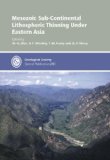 |
Mesozoic Sub-Continental Lithospheric Thinning under Eastern Asia The North China craton is the only known place where an Archaean craton with a thick tectospheric root lost half of that root in younger tectonism by processes such as delamination, convection, hydration-weakening, compositional change or some other mechanism. In this volume, authors provide data constraining the geometry and timing of root loss, aimed at understanding why and how continental roots are lost in general. Modelling how often this process may have occurred in the geological past, and how much lithospheric material has been recycled to the convecting mantle through this mechanism, could drastically change our current understanding of crustal growth rates and processes. Possible triggering mechanisms for root loss include collision of the South China (Yangtze) and North China cratons in the Triassic, the India-Asia collision, closure of the Solonker and Monhgol-Okhotsk oceans, Mesozoic subduction of the Pacific Plate beneath eastern China, impingement of mantle plumes, mantle hydration from long-term subduction and several rifting events. In this volume, we link studies of crustal tectonics with investigations aimed at determining the nature of and timing of the formation and loss of the root, in order to better-understand mechanisms of continental root formation, evolution and recycling/removal. |
 |
South-East Asian Oil, Gas, Coal and Mineral Deposits This companion volume to the author's Geological Evolution of South East Asia (1989) is the first and only book to give an analysis of the oil, gas, and mineral deposits of Southeast Asia, including its economic geology. The stratigraphy, structure, hydrocarbon and coal deposits of the major Tertiary basins are described, and regional similarities and differences are analyzed. Among the areas featured are the copper and gold-silver deposits of the Philippines and Indonesia; the Sundaland peninsular core, considered the foremost source of tungsten and tin; and the declining tin mines of Malaysia and Thailand. This comprehensive survey will interest both the economic geologist and researcher of oil and mineral deposits. |
 |
Encyclopedia of European and Asian Regional Geology This unique volume, organized alphabetically by country, provides a current overview of the general geology of Europe and Asia, excluding the Arab countries and Israel. Articles primarily contain information about the stratigraphy, structure, tectonics and natural resources of each country, as well as a history of geological exploration and other issues unique to each country. Additional articles cover international subjects such as Europe, Asia, the Alps, Caucasus, Himalayas and Tien Shan mountains. Many articles are new syntheses, e.g. those on Iceland, Burma and the Philippines; some are first-time descriptions in English, e.g. those on Estonia, Moldova, Bosnia and Turkmenistan; others are published for the first time ever in any language e.g. those articles on Italy, Korea and Vietnam. Each entry is typically written by a native geologist or a geologist with extensive experience in the region, and entries include representative figures illustrating main geologic features and a selected bibliography of relevant publications generally accessible in libraries. Articles are written assuming some general geological background. The Encyclopedia will serve as a valuable source book for libraries, and will be a key reference for academic and professional personnel in industrial exploration firms and governmental agencies, as well as for university students. |
 |
Cretaceous Environments of Asia This book presents a synthesis of the principal environmental characteristics of the Cretaceous in East and South Asia. The research was accomplished under IGCP project 350, which deals with the biological, climatological and physical environments of this region during the Cretaceous. This synthesis discusses aspects of stratigraphy, sedimentology, paleontology, geochemistry, tectonics, petrology, mineralogy, and geophysics. The research results are summarised by country, and include Far East Russia, Mongolia, eastern China, Korea, Japan, Philippines, Vietnam, Laos, Cambodia, Thailand, and India. Although these countries do not encompass the entire region, this coverage provides an excellent perspective of the evolution of the region during the Cretaceous. The records incorporated in this book present a wealth of marine and nonmarine data on climate, biotic diversity, circulation and chemistry of the ocean as well as fundamental plume tectonism. The latter appears to have caused much of the environmental change in this broad region, including both an enhanced greenhouse effect and high sea levels. |
 |
Tectonics, Magmatism and Metallogeny of Mongolia This volume provides the first systematic description of the most important geological structures of Mongolia and discusses the main features of these structures and their interactions. The main characteristics of magmatism are described for each stage of tectonic development and the evolution of magmatism is considered with reference to lithosphere development. Mongolia is a key region of the world and this volume provides a primary source of reference for postgraduates and researchers. |
 |
Geology of North-West Borneo: Sarawak, Brunei and Sabah The book is a comprehensive compilation of all aspects of the geology of Northwest Borneo (Sarawak, Brunei and Sabah) and the contiguous South China and Sulu Seas. The sedimentary formations are described, their palaeontology tabulated and ages discussed. Stratigraphic charts illustrate their relationships across the whole region. Detailed geological maps of selected areas are accompanied by cross sections based on outcrop patterns and drilling and seismic data offshore. Palaeocurrent maps are presented and the palaeogeography for different ages described and sedimentary provenance discussed. Descriptions of the ophiolite sequences, volcanic and plutonic rocks are accompanied by tables of selected chemical analyses and geochemical plots and their tectonic significance discussed. All radiometric data are tabulated and discussed. Regional structures and the predominantly Tertiary tectonics are described. In Sarawak the mountains are constructed of Upper Cretaceous to Lower Eocene greenschist facies shaly turbiditic Rajang Group, uplifted before the end of the Eocene. In Sabah the Western Cordillera is constructed of Eocene to Lower Miocene sandy turbidite uplifted in the Late Miocene and Pliocene. Miocene intrusion of Mount Kinabalu and uplift of the Cordillera is related to collision at the Northwest Borneo Trough. Gold, antimony, mercury and copper deposits are described and the tectonic setting of oil and gas deposits discussed. |
 |
The Tectonic and Climatic Evolution of the Arabian Sea Region |
 |
The Geology of Thailand This is the first volume in the English language to cover the entire range of the geology of Thailand since the joint Thai-US account by Brown et al. exactly 60 years ago. Over this period there has been a phenomenal growth in interest in this core area of SE Asia. This has been led by geologists in Thailand, but with important and highly significant input from geologists based elsewhere in Asia and in Europe, Australasia and North America. Some of that research was prompted by commercial considerations, since Thailand has important energy and mineral resources, while other research has sought to understand better the stratigraphic and structural history, including the plate-tectonic story which Thailands rocks reveal. This new volume seeks to bring together all of this knowledge into a single accessible book; it is the work of an international team drawn from Thailand, Japan, Australia, USA, Canada, Germany and the UK. |
 |
Cratons and Fold Belts of India Cratons and Fold Belts of India, is a unique attempt at presenting geological characteristics and evolution of the fold belts and the cratonic areas of the Indian shield. The author has evaluated the different evolutionary models for each fold belt in light of all the currently available geological and geochronological informations that are clearly listed. Shortcomings, if any, of each model are stated and a viable geodynamic model is presented for each fold belt. The book is self-contained – it includes an introduction to the processes of mountain building, especially plate tectonics theory with its application to the evolution of the Himalaya as an illustrative example – so that the reader can better appreciate the novel approach to the evolution of Proterozoic fold belts. The author eschews a detailed account of the fold belts for a clear description of all the concepts that go into building models. It is primarily written for graduate students, teachers and for those geoscientists who aspire to know all about the Indian shield. |