Fossil birds
- A drowned Mesozoic bird breeding colony from the Late Cretaceous of Transylvania

- A gigantic bird from the Upper Cretaceous of Central Asia
- A Large Accumulation of Avian Eggs from the Late Cretaceous of Patagonia (Argentina) Reveals a Novel Nesting Strategy in Mesozoic Birds
- A Lower Eocene Frigatebird from the Green River Formation of Wyoming (Pelecaniformes: Fregatidae)
- A new cormorant-like bird (Aves, Phalacrocoracoidea) from the Early Miocene of Rauscheröd (Southern Germany)
- A new Miocene penguin from Patagonia and its phylogenetic relationships
- A new parrot from the Miocene of Germany, with comments on the phylogenetic significance of hypotarsus morphology of the Psittacidae
- A primitive confuciusornithid bird from China and its implications for early avian flight
- A small galliform bird from the Lower Eocene Fur Formation, north-western Denmark
- All about Archaeopteryx
- Anatomy of the Early Cretaceous enantiornithine bird Rapaxavis pani
- Archaeopteryx
- Archaeopteryx & stuff
- Archaeopteryx Pages
- Avian biogeography on western Indian Ocean islands: eustatic sea levels, geological events and anthropogenic changes
- Avian Paleontology at the Close of the 20th Century: Proceedings of the 4th International Meeting of the Society of Avian Paleontology and Evolution, Washington D.C., 4-7 June 1996
- Bird Fossils and Evolution
- Body size evolution in Mesozoic birds: little evidence for Cope's rule
- Cenozoic Birds of the World
- Collected Papers in Avian Paleontology Honoring the 90th Birthday of Alexander Wetmore
- Completeness of the Fossil Record of Mesozoic Birds: Implications for Early Avian Evolution
- Cretaceous Birds of New Jersey
- Dinosaur-Bird Relationships
- Earliest record of the extant genus Spheniscus (Aves: Spheniscidae) - a new species from the Miocene of the Pisco Formation, Peru
- Early Vallesian vertebrates of Atzelsdorf (Austria, Late Miocene). 5. Aves
- Evolution. How birds became birds
- Evolution of the Cenozoic marine avifaunas of Europe
- Fossil Birds from the Oligocene Jebel Qatrani Formation, Fayum Province, Egypt
- Fossil evidence of avian crops from the Early Cretaceous of China
- Fossil Penguins
- Functional Morphometric Analysis of the Furcula in Mesozoic Birds
- Inferring flight parameters of Mesozoic avians through multivariate analyses of forelimb elements in their living relatives
- Insight into the growth pattern and bone fusion of basal birds from an Early Cretaceous enantiornithine bird
- Introduction
- Molecular development of fibular reduction in birds and its evolution from dinosaurs
- More about Archaeopteryx
- Morphological coevolution of the pygostyle and tail feathers in Early Cretaceous birds
- Multivariate analysis of neognath skeletal measurements: Implications for body mass estimation in Mesozoic birds
- New bird remains from the Middle Eocene of Guangdong, China
- New specimens of the earliest European passeriform bird
- Oldest fossil record of the extant penguin genus Spheniscus - a new species from the Miocene of Peru
- On the osteology and phylogenetic affinities of Morsoravis sedilis (Aves) from the early Eocene Fur Formation of Denmark
- Paleogene avifauna of the Holarctic
- Paleornithology of St. Helena Island, South Atlantic Ocean
- Previously Unrecognized Ornithuromorph Bird Diversity in the Early Cretaceous Changma Basin, Gansu Province, Northwestern China
- Quality of the fossil record of Mesozoic birds
- Rates of morphological evolution are heterogeneous in Early Cretaceous birds
- Reproduction in Mesozoic birds and evolution of the modern avian reproductive mode
- Revision of the phasianids (Aves, Galliformes) from the Early Miocene of Saint-Gérand-le-Puy (Allier, France)
- Society of Avian Paleontology and Evolution
- Soft-tissue and dermal arrangement in the wing of an Early Cretaceous bird: Implications for the evolution of avian flight
- Taxonomic identity of Eostega lebedinskyi Lambrecht, 1929 (Aves) from the middle Eocene of Romania
- “Terror Birds” (Phorusrhacidae) from the Eocene of Europe Imply Trans-Tethys Dispersal
- Two new late Pleistocene miniature owls from Rancho La Brea, California
- United States Geological Survey Professional Paper 264-J, Fossils Birds From Manix Lake California, by Hildegarde Howard; A Public Domain Document
Books about fossil birds
|
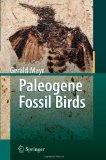
Paleogene Fossil Birds The present book is the first detailed review of the Paleogene avian fossil record on a worldwide scale. Numerous well-preserved fossil bird remains from this geological period, which covers the time span from the end of the Mesozoic era to the beginning of the Miocene, have been described in the past two decades. Some of these not only provide information on morphological transformations in the evolutionary history of the extant avian taxa, but are also of great significance for an understanding of their historical biogeography. Others represent extinct taxa which sometimes show a bizarre morphology not found in modern birds, such as the giant pseudo-toothed birds which reached wingspans up to six meters. The reader is introduced to basic morphological features of the various groups which, as far as possible, are placed into a phylogenetic context in the light of current hypotheses on the interrelationships of extant birds. In a concluding chapter the biogeographical significance of Paleogene fossil birds and possible reasons for faunal changes during the Paleogene are detailed. As such, the book not only aims at providing an overview for specialists, but may also help students of other fields of vertebrate paleontology to better understand Paleogene ecosystems. |
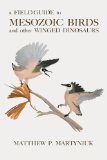 |
A Field Guide to Mesozoic Birds and Other Winged Dinosaurs A comprehensive illustrated guide to the birds of the Jurassic and Cretaceous periods and their dinosaurian forebears. Each species is illustrated in multiple views with size and distinguishing features highlighted. Includes introduction summarizing current research into bird origins and evolution, and what we know (and don't know) about the life appearance and habits of the first birds. |
 |
Taking Wing: Archaeopteryx and the Evolution of Bird Flight In 1861, just a few years after the publication of Charles Darwin's On the Origin of Species, a scientist named Hermann von Meyer made an amazing discovery. Hidden in the Bavarian region of Germany was a fossil skeleton so exquisitely preserved that its wings and feathers were as obvious as its reptilian jaws and tail. This transitional creature offered tangible proof of Darwin's theory of evolution. Hailed as the First Bird, Archaeopteryx has remained the subject of heated debates for the last 140 years. Are birds actually living dinosaurs? Where does the fossil record really lead? Did flight originate from the "ground up" or "trees down"? Pat Shipman traces the age-old human desire to soar above the earth and to understand what has come before us. Taking Wing is science as adventure story, told with all the drama by which scientific understanding unfolds. |
 |
Catalogue of the Fossil Birds in the British Museum This Elibron Classics book is a facsimile reprint of a 1891 edition by the British Museum, London. |